
Hard-Subtitle Removal: When a Managed Service Makes More Sense Than Another Tool
Software can perform an edit. A managed service takes responsibility for turning an entire batch into organized, reviewable video files.
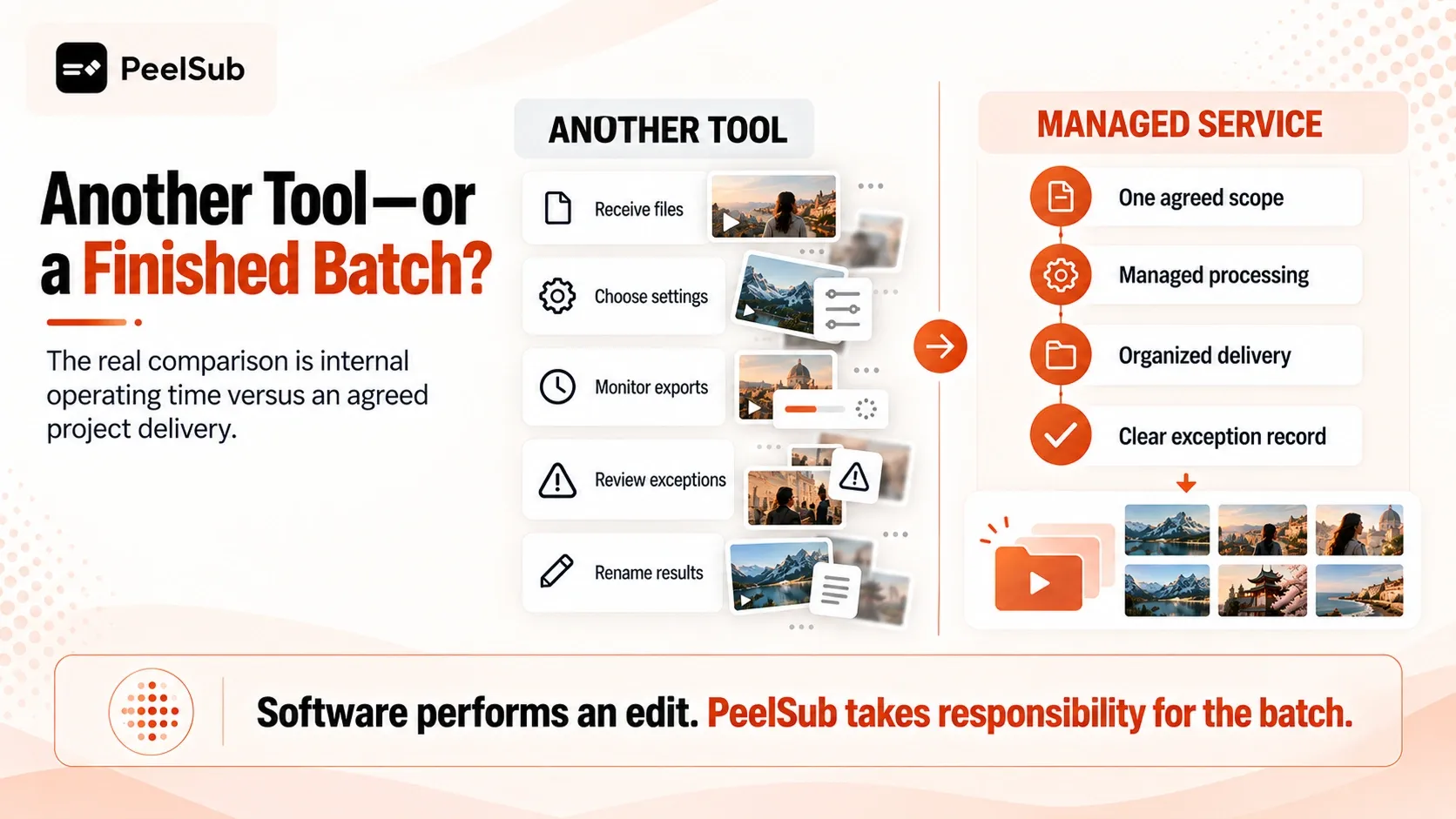
For a few straightforward clips, an internal editor may be the simplest answer. The economics change when a team has dozens of episodes, a localization deadline, and several downstream departments waiting for clean footage.
At that point, the comparison is not “tool versus no tool.” It is internal operating time versus an agreed project delivery.
Tools leave the surrounding workload with the client
Even when software automates part of the treatment, someone still has to receive the files, choose settings, identify exceptions, monitor exports, review difficult shots, rename results, and maintain the source-to-output relationship.
That effort is easy to overlook because it is spread across many small actions. It becomes visible when editors are pulled away from higher-value work and project managers spend their time reconciling folders and progress lists.
The real cost is continued use of skilled people
Editors are most valuable when they are making creative decisions: pacing a trailer, rebuilding a hook, adapting a frame, or preparing a market-specific cut. Repeating the same cleanup action across an entire series uses specialist time without using specialist judgment.

The opportunity cost extends beyond the edit team. Translation, dubbing, and captioning may be ready to proceed but still wait for a usable visual master. A cheap per-file method can become expensive when it blocks multiple downstream workflows.
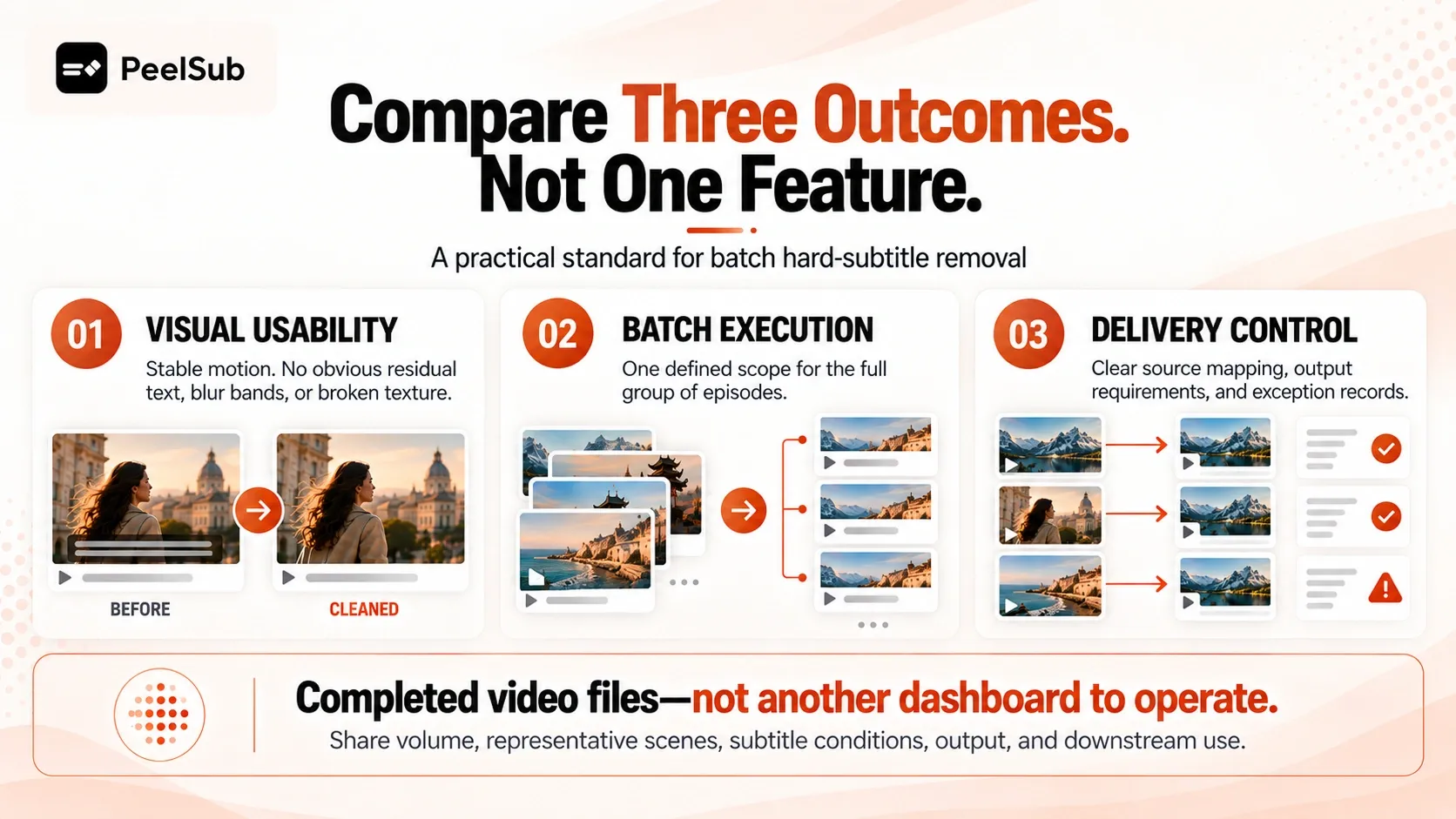
Compare three outcomes, not one processing feature
A batch subtitle-removal provider should be assessed on three dimensions:
- Visual usability: Does the former subtitle area remain stable in motion, without obvious residual text, blur bands, or broken texture?
- Batch execution: Can the provider handle a defined group of episodes under one scope rather than requiring the client to manage each file separately?
- Delivery control: Do processed files map clearly to the originals, with output requirements and exceptions documented?
If any of these is missing, the client still has to complete part of the project internally.
PeelSub takes on the batch as a service project
PeelSub is a managed hard-subtitle removal and frame-repair service for finished videos without clean masters. The workflow starts with representative footage so that subtitle position, motion, occlusion, effects, source quality, and acceptable limitations can be reviewed before the batch is approved.
PeelSub then processes the agreed scope and organizes the resulting videos against the source set. Original audio is retained by default, while format, codec, resolution, frame rate, naming, and other requirements are confirmed for the project.
The client receives completed video files and a clear exception record—not access to a dashboard that still needs an operator.
Outsource the repetitive layer when volume justifies it
A managed service is not automatically the best choice for every clip. It becomes compelling when volume, schedule, visual risk, and internal capacity turn subtitle removal into a recurring production burden.
If you are comparing internal processing with a managed batch, provide the number of videos, representative scenes, subtitle conditions, required output, and planned downstream use. PeelSub can evaluate whether the material fits a defined batch service scope.
Learn more about PeelSub
Visit the website: PeelSub official website
Submit your project: Contact us