
Remove Subtitles From an Entire Short-Drama Series Without Processing Each Episode Yourself
With dozens of episodes, the workload extends well beyond removing text. Repeated imports, exports, progress checks, and file organization can keep editors occupied long after the processing itself has become routine.

Importing a video, removing its burned-in subtitles, and exporting the result can seem straightforward. Across a series of 30, 50, or more episodes, the same actions keep returning. Someone also has to track progress, catch missing episodes, and make sure each output lands in the right place.
At that scale, the question becomes how to complete the whole series and hand over files the next team can use. PeelSub handles multiple episodes as a batch, removing fixed-position burned-in subtitles and organizing the processed videos to match their sources.
Episode-by-episode handling becomes a job of its own
An editor can usually fit a clip or two around other work: open the file, locate the subtitles, process the affected area, and export the result. A full series turns that manageable task into a repeated cycle.
Each episode has to enter processing, produce an output, and be checked before the editor moves on. The delay may come from the sheer repetition, even when no individual episode is especially difficult.
Progress tracking adds another responsibility. Which episode is finished? Which is still waiting? Which needs another look? An interruption from another project can leave a file missed, processed twice, or saved to the wrong folder.
With several people involved, those gaps spread. One person processes the videos, another organizes the files, and others prepare translation or new subtitles. If episode numbers and outputs do not line up, each collaborator spends time reconstructing the same information.
The useful measure is the work required to finish the series: repeated operations, progress tracking, and file handling all count. Timing a single removal task captures only part of that workload.
Repeated imports and exports take time away from production
Editors contribute judgment about pacing, shot selection, and how a video should work for its intended audience. Repeatedly opening files, checking subtitle locations, starting processing, and waiting for exports takes attention away from those decisions.
Across dozens of episodes, switching between files can occupy much of the day. The team stays busy, but less of that time goes into improving the content or preparing overseas versions.
The work also continues after subtitle removal. Outputs need to be organized by episode, checked, and handed to the people who will use them. A missing file, inconsistent name, or misplaced version creates another round of checking and rework.
Each interruption may be small. Together, they consume working time and repeatedly break the editor's concentration. Downstream production can also stall: a translated subtitle file may be ready, while the video needed for the new subtitled version is still waiting for cleanup.
A repetitive preparation task can become a source of delay across the localization workflow. Reducing the surrounding manual work matters as much as completing the subtitle removal itself.
Batch handling should reduce the repeated work around processing
Starting several videos at once addresses only one part of the problem. For a short-drama team, a useful batch workflow also changes how the material enters the job and how the results come back.
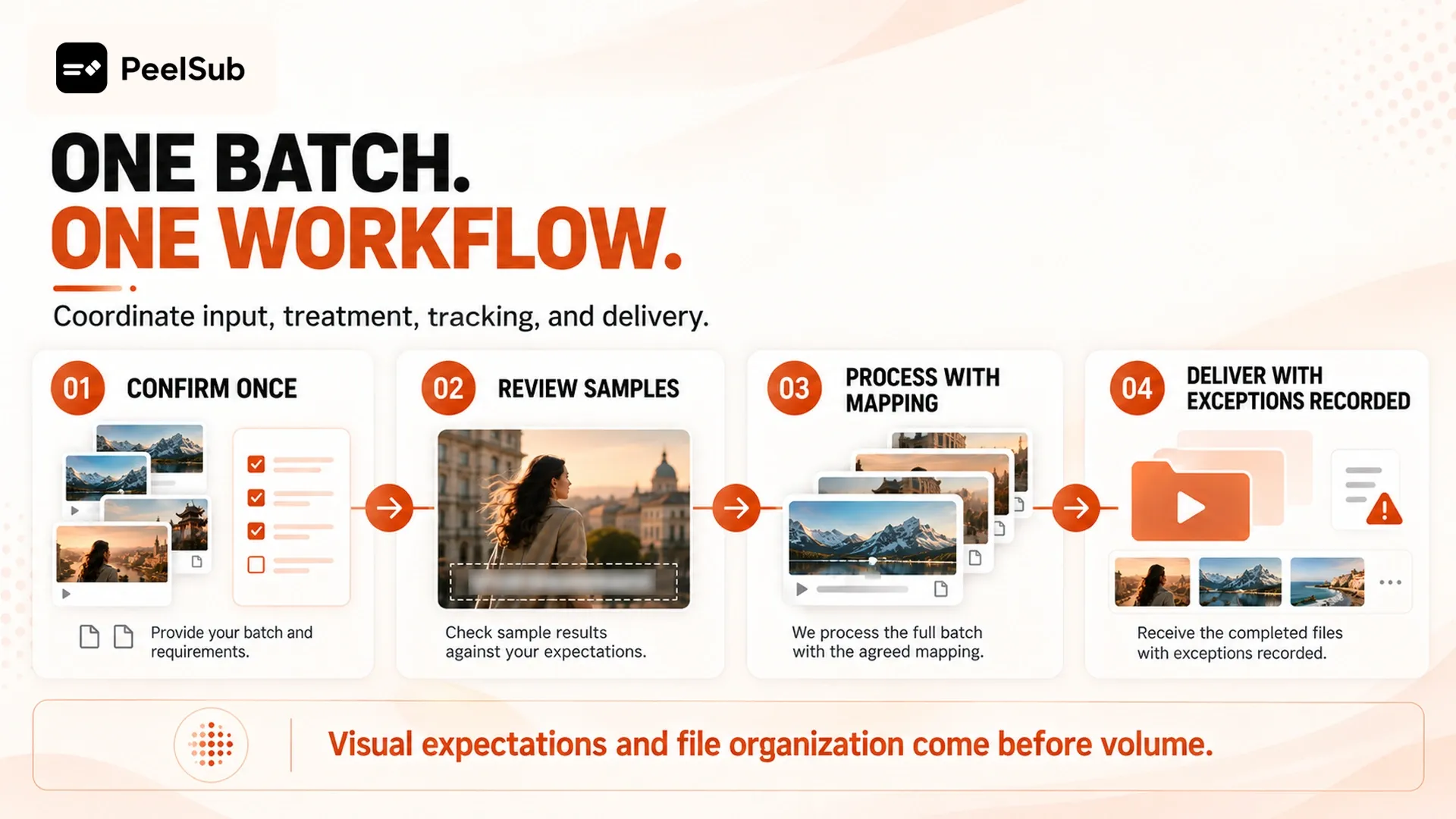
The series can be handed over together, its fixed-position subtitles processed as a batch, and the outputs organized against the original episodes and files. The client does not have to create a separate task for every episode or rebuild the running order from scattered results.
That approach reduces the client's repeated task setup, export monitoring, renaming, and sorting. Editors spend less time moving between folders to find completed videos or checking the status of each individual file.
An organized batch also gives later collaborators a clearer starting point. Translation, dubbing, and new subtitle production can be planned around a corresponding set of videos, with less time spent identifying isolated outputs.
Batch efficiency includes the operational work the team no longer has to repeat for every episode. The benefit should remain visible when the processed files reach the next stage.
PeelSub handles subtitle removal and organizes the batch
PeelSub is a managed service for removing fixed-position burned-in subtitles from video. A short-drama team can submit a series together, allowing the processing to proceed without requiring its editors to operate each episode as a separate job.
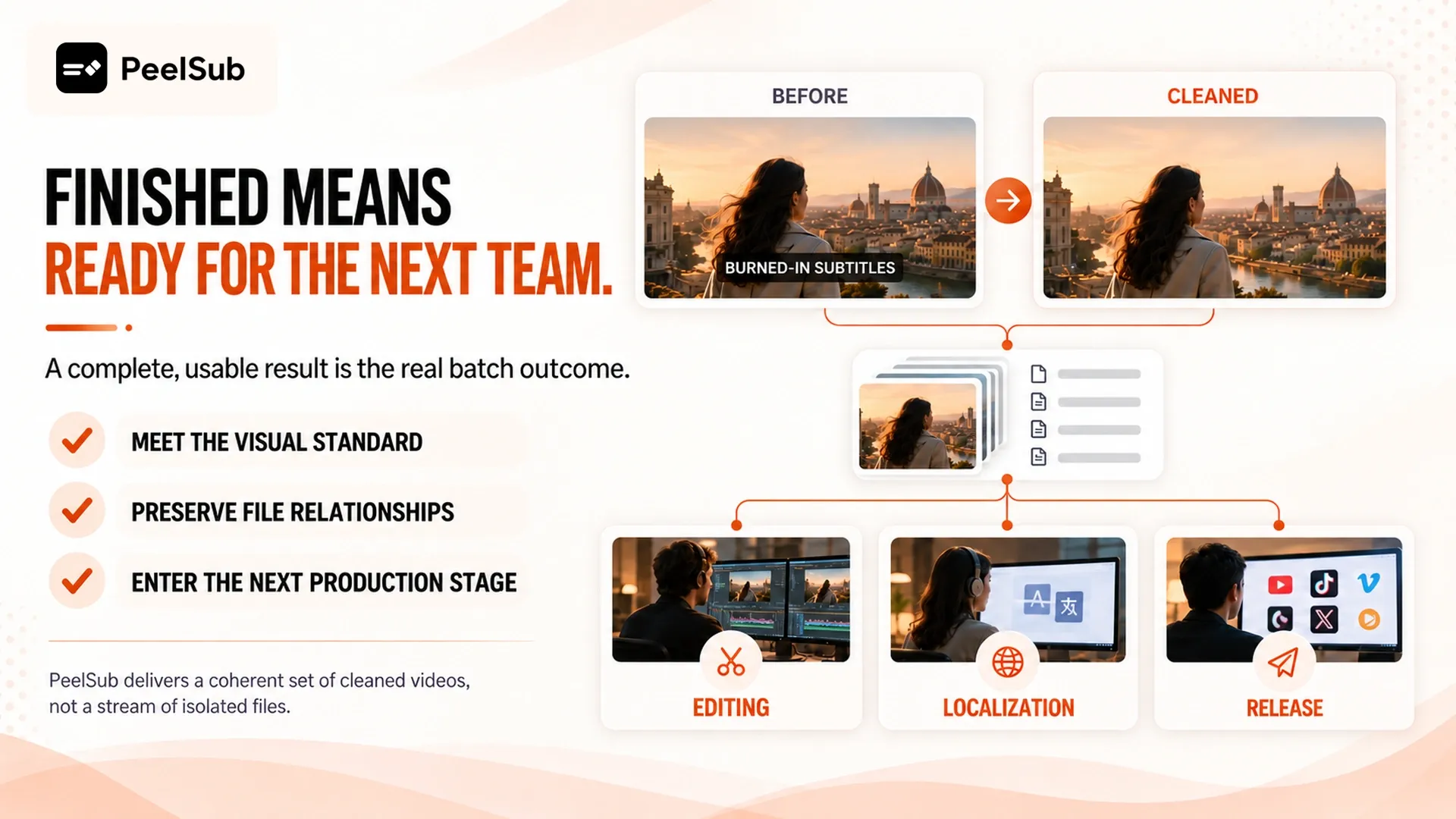
PeelSub identifies the subtitle region, removes the text, and reconstructs the local image areas it covered. This avoids relying on a solid mask or a blurred band to hide the words. The aim is to remove the subtitles while preserving as much of the original picture's clarity and integrity as possible.
The processed videos are organized to correspond to the source material and episode sequence. That makes it easier for the team to continue with translation, new subtitle placement, dubbing, or overseas versions without first rebuilding the file relationships.
For a multi-episode project, the service covers both the subtitle treatment and the organization needed for a useful handoff. The client submits the batch and receives its corresponding results, reducing the repeated processing and file-management work on the editing team.
Hand over the series and give editors time for the content
The time saved through batch handling includes all the switching, waiting, progress checking, and sorting that accumulates across a series. Keeping the material together reduces the need to chase individual episodes and locate outputs spread across different folders.
When results come back matched to the original episodes, the project lead can plan the next production stage around an organized set of material. Editors can devote more attention to the creative decisions that still need them.
For a short drama, video series, or collection being prepared for an international market, provide the video files or accessible material links, episode count, subtitle locations, and intended use. PeelSub can handle fixed-position subtitle removal, local image reconstruction, and result organization for the batch.
Treating the series as one project gives the editing team more time to work on the content itself.
Learn more about PeelSub
Visit the website: PeelSub official website
Submit your project: Contact us